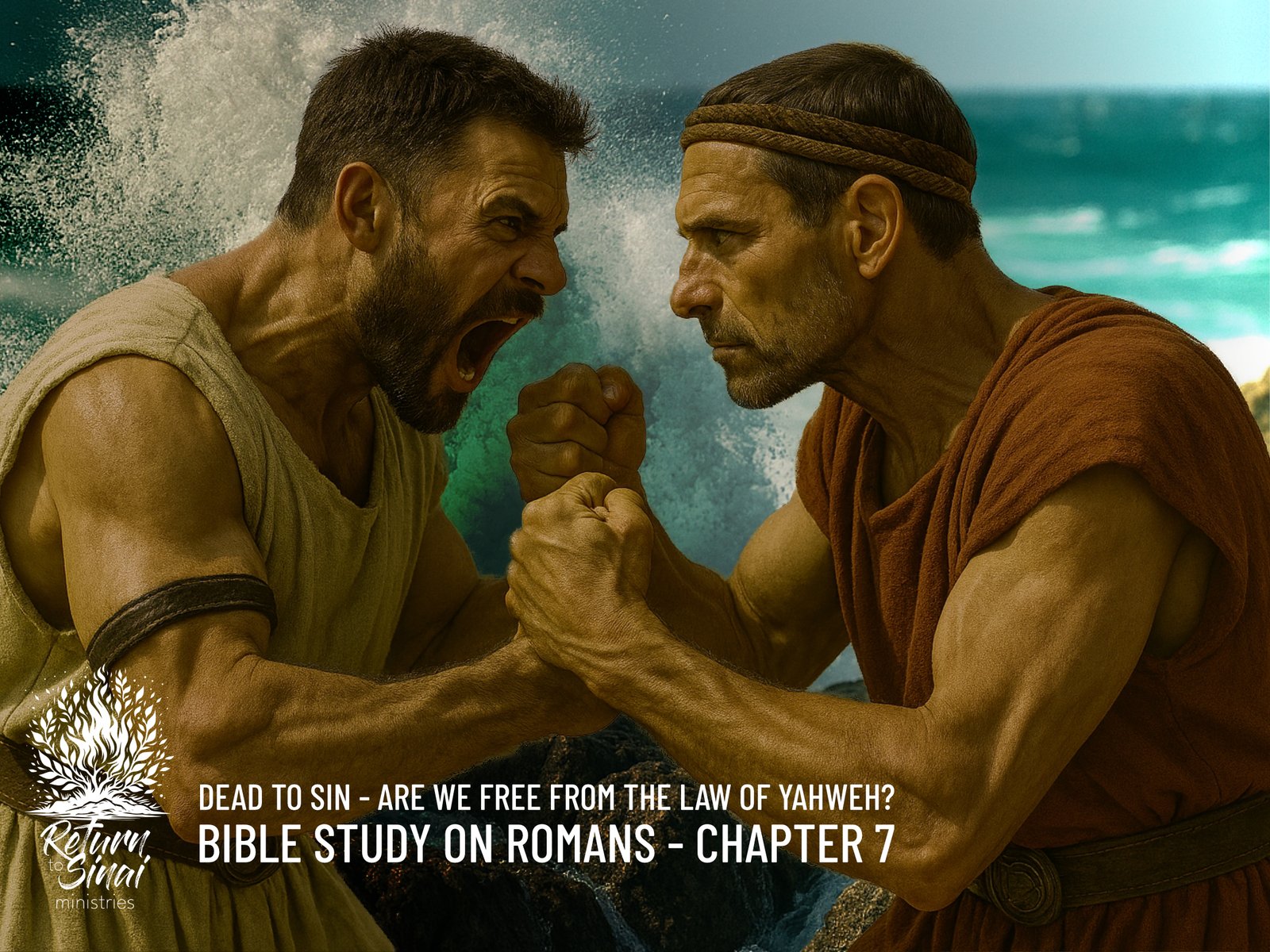
Are we free from the Law of Yahweh?
Previously in Romans…
On chapter 1, Paul makes us aware of the power that governed over us, the law of death, which it is manifested in us as sin, and Paul speaks how many has conformed to a life of sin, not only by ignoring acts of sin, but even give approval of those practices.
In chapter 2 and 3 Paul confronts us, Jews and Gentiles, to the reality that governs us, dividing us into unnecessary arguments and discussions. Based on traditions of men, and our love to stay under the influence of ideas that are not conform to Yahweh but to the traditions we make for ourselves.
In chapter 4, 5 and 6, Paul challenges us, both Jews and Gentiles, to grow beyond our misunderstanding since our faith do not come from anything we do but because of the promises made by Yahweh. We are saved by our belief in those promises. More specifically, to the promise of our Messiah Yeshua. But there’s a problem we need to confront wholeheartedly—we are to fight against the ruling of sin and surrender to the One who liberated us from the bondage of sin.
With that clarified, let’s begin!
Romans Chapter 7
Which Law Do I Follow? If Any at All!
Romans 7:1-6 LSB ~ Or do you not know, brothers—for I am speaking to those who know the law—that the law is master over a person as long as he lives? For the married woman has been bound by law to her husband while he is living, but if her husband dies, she is released from the law concerning the husband. So then, if while her husband is living she is joined to another man, she shall be called an adulteress. But if her husband dies, she is free from the law, so that she is not an adulteress though she is joined to another man. So, my brothers, you also were made to die to the Law through the body of Christ, so that you might be joined to another, to Him who was raised from the dead, in order that we might bear fruit for God. For while we were in the flesh, the sinful passions, which were aroused by the Law, were at work in our members to bear fruit for death. But now we have been released from the Law, having died to that by which we were constrained, so that we serve in newness of the Spirit and not in oldness of the letter.
At the end of chapter 6, Paul explains that we are no longer bound by the law of sin. Because these passages are divided into chapters, it’s vital to follow Paul’s argument closely; reading Romans in isolated sections can lead to misunderstandings, as history has shown. Staying focused on the overall message helps clarify which law applies to us and which one we have been freed from.
For our convenience, in this commentary I started to separate the two with the uppercase Law —which is Torah— and the lowercase “law” —which could be the law of sin or the traditions of men—. Paul very explicitly says that all believers are mastered by the Law for as long as we live. Because of this, Paul draws an illustration that’s only true if we are under the Law of Yahweh. Paul is referring about the Law of Marriage and is drawing a comparison how once we were bound under the law of sin because we were married metaphorically to death, but we are no longer under this law of sin, because Yeshua killed the dominion of death, by faith.
Since Paul knows that many will take advantage of this illustration to use it as an excuse to deny our responsibility under a covenantal agreement between Yeshua (Yahweh with us) and us, then Paul continues with the following statement:
Romans 7:7 LSB ~ What shall we say then? Is the Law sin? May it never be! Rather, I would not have come to know sin except through the Law. For I would not have known about coveting if the Law had not said, “YOU SHALL NOT COVET.”
We must exercise caution and avoid jumping to that conclusion, as we are not exempt from the Law of Yahweh. However, Paul makes a startling statement, asserting that we have become victims—believing that our oppressor is the Law of Yahweh. In reality, we have unintentionally reattached ourselves to the law of sin, convinced that we are serving the Law of Yahweh. Wait, what?! Could you clarify that again?
Romans 7:8-11 LSB ~ But sin, taking opportunity through the commandment, worked out in me coveting of every kind. For apart from the Law sin is dead. Now I was once alive apart from the Law, but when the commandment came, sin revived and I died; and this commandment, which was to lead to life, was found to lead to death for me. For sin, taking an opportunity through the commandment, deceived me and through it killed me.
What a rollercoaster of words, what is happening here? So, let me see if I get this straight, the Law is not sin, but sin has taken advantage of the Law? I’m about to have an aneurysm. Let’s break this down slowly.
Paul has emphasized that the Law is essential for understanding what constitutes sin. Given this, how can sin exploit the Law’s presence to lead me into further sin and ultimately cause my spiritual death?
First, we need to understand the timing of Paul’s speech — specifically, the “when” he is referring to. Paul is guiding us to a period when the Law of Yahweh was not ingrained in humanity’s hearts, a time when sin reigned unchecked and without restraint. You might assume he was describing his contemporary era, the time he was writing, but in reality, he is taking us on a historical journey. Imagine the passages from Genesis chapters 3 through 11, from the fall of mankind and the descent into sin’s dominion, to the events of Noah’s Ark and the Tower of Babel.
And they said, “Come, let us build for ourselves a city, and a tower whose top will reach into heaven, and let us make for ourselves a name, lest we be scattered over the face of the whole earth.”
Genesis 11:4 • Legacy Standard Bible (LSB)
Consider the statement: “Let us make for ourselves a name.” This marks the first recorded instance of humanity coming together in unity, albeit with misguided intentions. The people of Shinar, originally not from the region, migrated there under the leadership of Nimrod, a formidable figure regarded as the first to claim divinity in political matters. Nimrod aspired to construct a tower reaching the heavens; at that time, it was believed that both the heavens and the earth were supported by pillars. His intention was to build a structure capable of holding back the waters above—the heavens—in anticipation of any future judgment from Yahweh upon humanity.
Notably, Noah was still alive at this point, so people were aware of Yahweh’s promise to creation.
And Yahweh smelled the soothing aroma; and Yahweh said to Himself, “I will never again curse the ground because of man, for the intent of man’s heart is evil from his youth; and I will never again strike down every living thing as I have done. While all the days of the earth remain, seedtime and harvest, and cold and heat, and summer and winter, and day and night shall not cease.”
Genesis 8:21-22 • Legacy Standard Bible (LSB)
Second. There is a clear pattern: Nimrod used political power to distort truth, mislead others, and defy Yahweh’s authority. Influenced by larger forces, people were unaware of Yahweh’s Law. When their language was confused, humanity was dispersed across the earth, showing that another flood was unnecessary for this outcome.
Today we use other forms of manipulations that we should be careful not to fall into.
- The Law is too difficult to follow. This is often the first excuse that you hear from doctrines that do not want to be under anyone’s rules, but their own. But this statement makes Yahweh a liar. Yahweh testify through Moses that the Law was not difficult to be followed. (Deuteronomy 30:11-14, 1 John 5:3, Matthew 11:29-30, Romans 10:6-8, 1 Corinthians 10:13).
- The Law of Moses is only for the Jews. Lamentably, this is a lie promoted by all the doctrines created by men, from Judaism to Evangelicals and some Messianic doctrines. This is too sad, and I’m praying for whoever reads this post, the love of Yahweh represented by His Law, it is revealed to you. Israel was supposed to be the pilot for all of us, Yeshua, is the fulfillment of the Law, which means, Yeshua made it available for us. (Exodus 12: 48-5, Leviticus 24:22, Numbers 15:16-19, Numbers 15:27-31, Isaiah 2:2-4, Micah 4:1-3, Ezekiel 11:17-21, Ezekiel 36:26-28).
- Yeshua fulfilled the Law, so we do not have to follow, He follows it for us. This is the worst of the fallacies we have been told for centuries, but this is farther from the truth for as far as this doctrine could be from the truth of Yeshua. The Law was written to show us how to love properly. Not based on our definition of love, but from Yahweh’s perspective. After all, Yahweh is love. (Matthew 5:15-19, Matthew 22:37-43, Romans 13:9-12, Galatians 5:12-17)
That is why Paul continues:
Romans 7:12 LSB ~ So, the Law is holy, and the commandment is holy and righteous and good.
Where exactly does the conflict lie? Is my obligation to adhere to the Law?
That’s a very important question you should ponder repeatedly throughout your day, and probably until the day Yeshua returns or you are gather with your kin. The Law of Yahweh is not the culprit of our failures, but it is the sin in us who makes the Law difficult for us to follow.
Romans 7:13 LSB ~ Therefore did that which is good become a cause of death for me? May it never be! Rather it was sin, in order that it might be shown to be sin by working out my death through that which is good, so that through the commandment sin would become utterly sinful.
The very reason we despise the Law of Yahweh is because it reveals how sinful and corrupted we are, it shows how our lust urges to do what right for our selfish desires and how deep our love for darkness is rooted.
Through the commandment sin would become utterly sinful
And this is where the line is drawn in the sand. The Law of Yahweh purpose is to reveal Yahweh’s perfect plan for creation. While our lust devours it.
Romans 7:14-15 LSB ~ For we know that the Law is spiritual, but I am fleshly, having been sold into bondage under sin. For what I am working out, I do not understand; for I am not practicing what I would like to do, but I am doing the very thing I hate.
We are unable to escape it; we are inherently committed to sin, as Yahweh proclaimed to Adam.
Genesis 3:17b LSB ~ Cursed is the ground because of you; In pain you will eat of it All the days of your life.
But Yeshua set up free from this bondage, He circumcised our hearts, He destroyed in us the heart of stone and gave us a heart of flesh. For what?
And I will give them one heart and give within them a new spirit. And I will take the heart of stone out of their flesh and give them a heart of flesh, that they may walk in My statutes and keep My judgments and do them. Then they will be My people, and I shall be their God.
Ezekiel 11:19-20 • Legacy Standard Bible (LSB)
And this is the battle Paul is striving to clarify for us. Yeshua has provided us with the tools necessary to conquer death and overcome sin. Yet, Yahweh remains faithful and merciful; He understands that we are journeying through the wilderness. However, He also expects us to learn and grow during this time, so that we may live continuously under His guidance.
God is preparing us to live an eternal life; He disciplines us because He loves us and because He is forming us to shine with the light of Yeshua. A father who does not care for his children will not care if they succeed or perish, but a father who cares about his children will discipline and set goals for his children to follow, so they can be successful in life.
Yahweh cares, that is why He gave us His Law, Torah. Through it we learn what it means to be His children, and to reflect His Image. He is making us lamps that sit on top of tables in the middle of darkness. We are Yahweh’s expression: “Be the light”, in a world of darkness, corruption and sin. And yet:
Romans 7:17-20 LSB ~ So now, no longer am I the one working it out, but sin which dwells in me. For I know that nothing good dwells in me, that is, in my flesh; for the willing is present in me, but the working out of the good is not. For the good that I want, I do not do, but I practice the very evil that I do not want. But if I am doing the very thing I do not want, I am no longer the one working it out, but sin which dwells in me.
We must surrender to the guidance of the Holy Spirit of Yahweh. Without His wisdom, we are truly lost. Even our most genuine acts of goodness are often motivated by our own desire for satisfaction. Only the Spirit of Yahweh can transform our hearts, empowering us to do what is truly good without compromising the foundation established by Yeshua the Messiah.
For all of us have become like one who is unclean, And all our righteous deeds are like a filthy garment; And all of us wither like a leaf, And our iniquities, like the wind, carry us away. There is no one who calls on Your name, Who awakens himself to take hold of You, For You have hidden Your face from us And have melted us into the hand of our iniquities. But now, O Yahweh, You are our Father; We are the clay, and You our potter; And all of us are the work of Your hand. Do not be angry beyond measure, O Yahweh, Nor remember iniquity forever; Behold, look now, all of us are Your people.
Isaiah 64:6-9 • Legacy Standard Bible (LSB)
Through Yeshua, we have assurance that Yahweh is not excessively angry with us. He cares for us, provides a way to return to Him through His Son, and enables us to follow and practice His statutes and judgments.
“But this is the covenant which I will cut with the house of Israel after those days,” declares Yahweh: “I will put My law within them, and on their heart I will write it; and I will be their God, and they shall be My people.
Jeremiah 31:33 • Legacy Standard Bible (LSB)
This is our hope and our conviction: the unwavering faith that propels us forward. We believe that one day, we will be able to adhere perfectly to His Law, and the power of sin will be entirely abolished. In that moment, we will live a life free from death, pain, and suffering. Amen.
But in the meantime:
Romans 7:21-24 LSB ~ I find then the principle that in me evil is present—in me who wants to do good. For I joyfully concur with the law of God in the inner man, but I see a different law in my members, waging war against the law of my mind and making me a captive to the law of sin which is in my members. Wretched man that I am! Who will deliver me from the body of this death?
Paul distinguishes between the law of sin and the Law of Yahweh, both influencing our lives. While one side seeks to satisfy our desires, the spirit in us calls us to a higher path. Bound to a mortal body, we struggle with this inner conflict until Yeshua returns to free us from death.
Although death has been overcome, it remains an inevitable part of the human experience. Nevertheless, we maintain hope—a promise that instills faith within us, reminiscent of the faith exhibited by Abraham and David. As Paul further elaborates…
Romans 7:25 LSB ~ Thanks be to God through Jesus Christ our Lord! So then, on the one hand I myself with my mind am serving the law of God, but on the other, with my flesh the law of sin.
Conclusion
When Paul speaks of being “free from the law,” it is important to understand that he is referring to the law of sin—the burden from which our Passover Lamb has set us free. Although we remain in this world—a prison house of our mortal bodies, wandering through the wilderness of a decaying, fallen world—we are not without hope.
Through the Word of Yahweh, we have seen the promises made to Israel serving as a testimony of His unwavering faithfulness. We should envision ourselves in the place of Israel—sharing in their victories and failures, their moments of triumph and times of hardship—realizing that we are not so different from them. There are moments of genuine devotion, such as when Israel faithfully followed Yahweh’s commands to build the tabernacle, making a dwelling for His presence among them. Yet, we also face times of failure, wandering in defeat toward our own Babylon—seasons of sorrow, struggle, and adversity.
But despite all, Yahweh has been faithful, merciful and full of loving kindness. Yahweh, not considering Himself be the Most‑High Elohim, He became flesh, providing us a lamb of redemption, and by the blood He shed as Yeshua, He gave us new life. And by His love, He gifted us with His Ruaḥ HaKodesh (Holy Spirit), who guide us as a column of clouds by day, and a column of fire by night.
The Law of Yahweh is a vital cornerstone of our lives. If you have been misled by a deceptive doctrine claiming otherwise, allow me to remind you of Yeshua’s own words.
Whoever then annuls one of the least of these commandments, and teaches others to do the same, shall be called least in the kingdom of heaven; but whoever does and teaches them, he shall be called great in the kingdom of heaven.
Matthew 5:19 • Legacy Standard Bible (LSB)
Always remember you are no longer a slave to sin, for you are alive in Yeshua’s love—love that embodies the Torah.
I sincerely hope this Bible commentary brings you great blessing. My prayer is that Yahweh reveals to you His immense love for you through these reflections. Until next time, as we delve into Romans 8.
“May Yahweh bless you and keep you; May Yahweh make His face shine upon you and be gracious to you; May Yahweh lift up His face towards you and give you Shalom.”
Leave a Reply