For the past couple of months, I’ve been working on a multi-language project, studying the Didache—a 1st-century document believed to contain the Apostles’ instructions to the emerging grafted-in ecclesia.
The Didache—διδαχή (dee-dah-KHAY), the Greek word for “Teaching,” with its Hebrew equivalent being “Torah,” is a collection of guidance and instructions that the early community of believers used to preserve sound doctrine and build a strong foundation.
What’s really interesting about the Didache is its format and literary style. If you’ve ever read part of the Talmud, the collection of teachings and commentaries on the Torah from Orthodox Judaism, you might notice the Didache is written in a similar way. Like the Talmud, which means “Discipleship,” the Didache is structured as an instructional manual designed to guide a community in building a life of righteousness together.
Many scholars consider the Didache to be Apocryphal literature, but I beg to differ. Unlike most Apocryphal works, “The Teachings of the Twelve Apostles,” as the Didache is fully known, may have been written or inspired by the Twelve Apostles themselves, if the authorship is accurate—apostles who were filled with the Holy Spirit. Most of the Apocrypha, on the other hand, was written during a time when there were no prophets in the land of Israel.
As one of the books of the 1st Maccabees 4:46 stated:
and stored the stones in a suitable place on the temple hill until a prophet should appear on the scene to determine what should be done with them.
1 Maccabees 4:46 • New Catholic Bible (NCB)
And also:
There was great distress in Israel, the likes of which had not been since the days when the prophets ceased to appear among them.
1 Maccabees 9:27 • New Catholic Bible (NCB)
Yahweh spoke through prophets and later through His own Son, Yeshua. After Yeshua, other Holy Spirit-led prophets emerged, like Hagab (Agabus), who prophesied about the famine during Emperor Claudius’s reign (Acts 11:27-30) and foretold Saul’s arrest (Acts 21:10-27). This also included the Apostles themselves, who were baptized with the Spirit in Acts 2..
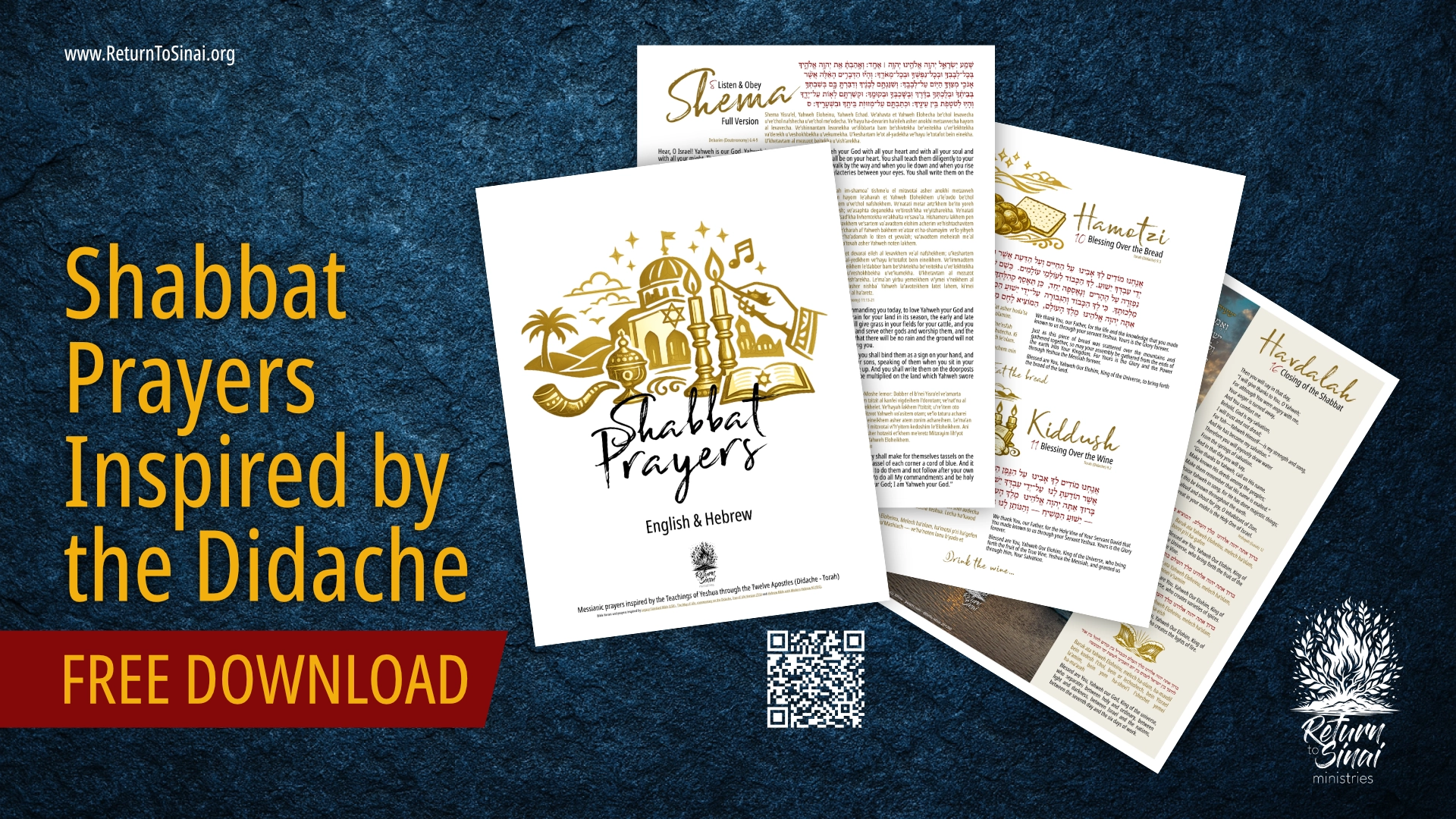
In the downloadable document included with this article, you’ll find prayers inspired by the Apostles, who carry on the same traditions their fathers observed during Shabbat and other moments in daily life. The document is a beautiful work that aims to blend tradition with the new way of living introduced by Yeshua for new believers across the nations.
For example, their guidance on how to pray for the bread is as follows:
We thank You, our Father, for the life and the knowledge that you made known to us through your servant Yeshua. Yours is the Glory forever. Just as this piece of bread was scattered over the mountains and gathered together, so may your assembly be gathered from the ends of the earth into Your Kingdom. For Yours is the Glory and the Power through Yeshua the Messiah forever.
Didache 9:3 • The Two Way (Didache FFZO)
You can read the Didache online in this link, or you can get a more beautiful translation here (The Two Ways by FFOZ).
I hope these Shabbat Prayers (English/Hebrew), inspired by the teachings of Yeshua through the Twelve Apostles, also known as the Didache, are a great blessing for your family as they are for mine.
Leave a Reply