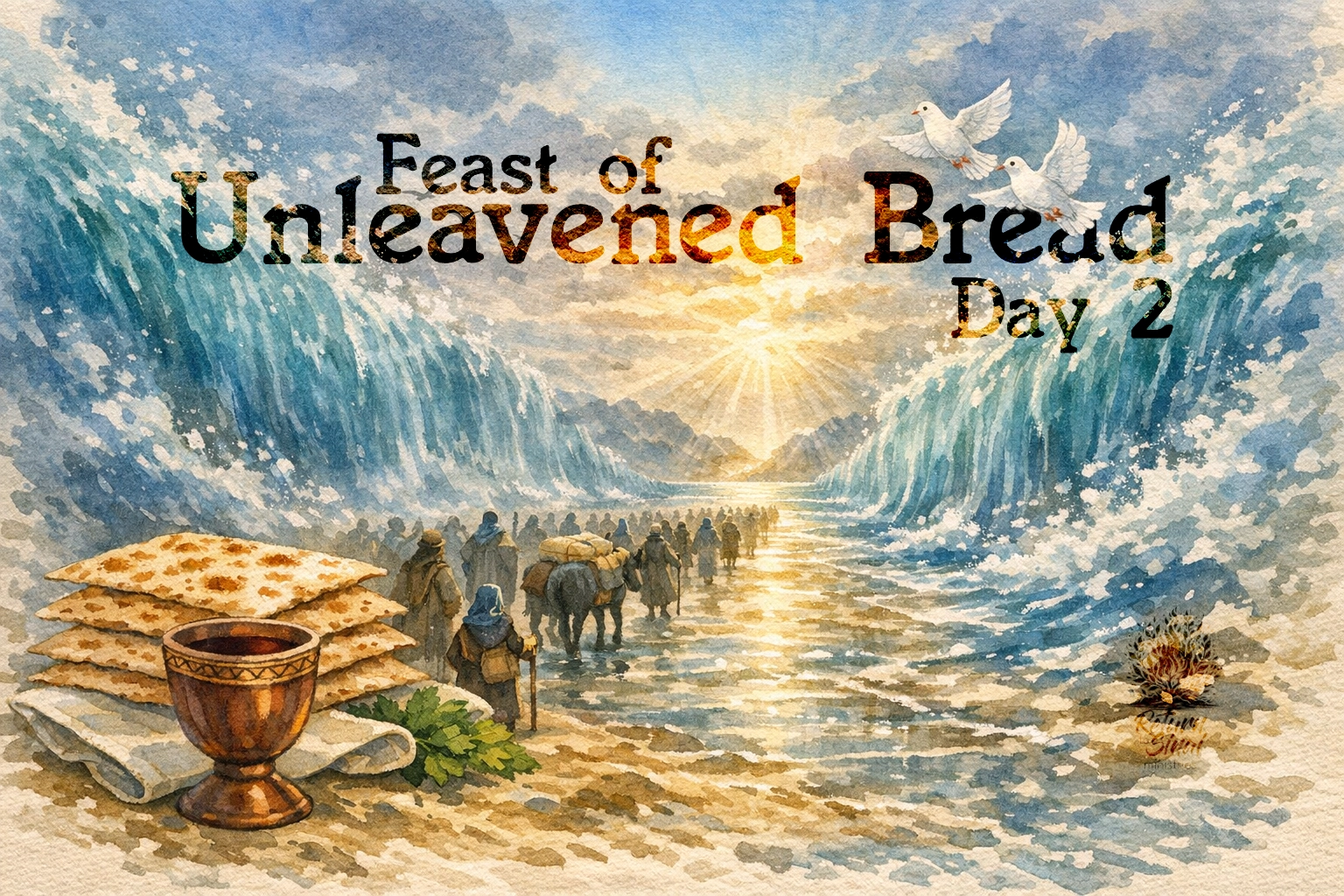
Feast of Unleavened Bread – Day 2
Suggested Readings:
Torah: Shemoth (Exodus) 13:6‑7; 23:15; 34:18; Vayikra (Leviticus) 22:26‑33; 23:1‑44;
Haftarah: Melaḵim Bĕt (2 Kings) 23:1-9; 21-25; Zeḵaryah (Zechariah) 3:9;
Brit Cha-Dashah: Marqos (Mark) 16: 1-8; Luqas (Luke) 22:19; Romiyim (Romans) 6:11; 11‑18; Titos (Titus) 2:13‑14
Torah (Teachings)
— Suggested Readings
Shemoth (Exodus) 13:6-7 (LSB)
For seven days you shall eat unleavened bread, and on the seventh day there shall be a feast to Yahweh. Unleavened bread shall be eaten throughout the seven days; and nothing leavened shall be seen among you, nor shall any leaven be seen among you in all your borders.
Shemoth (Exodus) 23:15 (LSB)
You shall keep the Feast of Unleavened Bread; for seven days you are to eat unleavened bread, as I commanded you, at the appointed time in the month Abib, for in it you came out of Egypt. And none shall appear before Me empty-handed.
Shemoth (Exodus) 34:18 (LSB)
“You shall keep the Feast of Unleavened Bread. For seven days you shall eat unleavened bread, which I commanded you, at the appointed time in the month of Abib, for in the month of Abib you came out of Egypt.
Vayikra (Leviticus) 22:26-33 (LSB)
Then Yahweh spoke to Moses, saying, “When an ox or a sheep or a goat is born, it shall remain seven days with its mother, and from the eighth day on it shall be accepted as a sacrifice of an offering by fire to Yahweh. But, whether it is an ox or a sheep, you shall not slaughter both it and its young in one day. And when you sacrifice a sacrifice of thanksgiving to Yahweh, you shall sacrifice it so that you may be accepted. It shall be eaten on the same day; you shall leave none of it until morning; I am Yahweh. So you shall keep My commandments and do them; I am Yahweh. “And you shall not profane My holy name, but I will be treated as holy among the sons of Israel; I am Yahweh who makes you holy, who brought you out from the land of Egypt to be your God; I am Yahweh.”
Vayikra (Leviticus) 23 (LSB)
And Yahweh spoke again to Moses, saying, “Speak to the sons of Israel and say to them, ‘The appointed times of Yahweh which you shall proclaim as holy convocations—My appointed times are these: ‘For six days work may be done, but on the seventh day there is a sabbath of complete rest, a holy convocation. You shall not do any work; it is a sabbath to Yahweh in all your places of habitation. ‘These are the appointed times of Yahweh, holy convocations which you shall proclaim at the times appointed for them. In the first month, on the fourteenth day of the month at twilight is the Passover of Yahweh. Then on the fifteenth day of the same month there is the Feast of Unleavened Bread to Yahweh; for seven days you shall eat unleavened bread. On the first day you shall have a holy convocation; you shall not do any laborious work. But for seven days you shall bring near an offering by fire to Yahweh. On the seventh day is a holy convocation; you shall not do any laborious work.’” Then Yahweh spoke to Moses, saying, “Speak to the sons of Israel and say to them, ‘When you enter the land which I am going to give to you and reap its harvest, then you shall bring in the sheaf of the first fruits of your harvest to the priest. And he shall wave the sheaf before Yahweh for you to be accepted; on the day after the sabbath the priest shall wave it. Now on the day when you wave the sheaf, you shall offer a male lamb one year old without blemish for a burnt offering to Yahweh. Its grain offering shall then be two-tenths of an ephah of fine flour mixed with oil, an offering by fire to Yahweh for a soothing aroma, with its drink offering, a fourth of a hin of wine. Until this same day, until you have brought in the offering of your God, you shall eat neither bread nor roasted grain nor new growth. It is to be a perpetual statute throughout your generations in all your places of habitation. ‘You shall also count for yourselves from the day after the sabbath, from the day when you brought in the sheaf of the wave offering; there shall be seven complete sabbaths. You shall count fifty days to the day after the seventh sabbath; then you shall bring a new grain offering near to Yahweh. You shall bring in from your places of habitation two loaves of bread for a wave offering, made of two-tenths of an ephah; they shall be of a fine flour, baked with leaven as first fruits to Yahweh. Along with the bread you shall bring near seven one year old male lambs without blemish and a bull from the herd and two rams; they shall be a burnt offering to Yahweh, with their grain offering and their drink offerings, an offering by fire of a soothing aroma to Yahweh. You shall also offer one male goat for a sin offering and two male lambs one year old for a sacrifice of peace offerings. The priest shall then wave them with the bread of the first fruits for a wave offering with two lambs before Yahweh; they shall be holy to Yahweh for the priest. On this same day you shall make a proclamation as well; it shall be a holy convocation for you. You shall do no laborious work. It is to be a perpetual statute in all your places of habitation throughout your generations. ‘When you reap the harvest of your land, moreover, you shall not reap to the very corners of your field nor gather the gleaning of your harvest; you are to leave them for the afflicted and the sojourner. I am Yahweh your God.’” Again Yahweh spoke to Moses, saying, “Speak to the sons of Israel, saying, ‘In the seventh month on the first of the month you shall have a rest, a memorial by blowing of trumpets, a holy convocation. You shall not do any laborious work, but you shall bring an offering by fire near to Yahweh.’” And Yahweh spoke to Moses, saying, “On exactly the tenth day of this seventh month is the day of atonement; it shall be a holy convocation for you, and you shall humble your souls and bring an offering by fire near to Yahweh. And you shall not do any work on this same day, for it is a day of atonement, to make atonement on your behalf before Yahweh your God. If there is any person who will not humble himself on this same day, he shall be cut off from his people. And as for any person who does any work on this same day, that person I will cause to perish from among his people. You shall do no work at all. It is to be a perpetual statute throughout your generations in all your places of habitation. It is to be a sabbath of complete rest to you, and you shall humble your souls; on the ninth of the month at evening, from evening until evening you shall keep your sabbath.” Again Yahweh spoke to Moses, saying, “Speak to the sons of Israel, saying, ‘On the fifteenth of this seventh month is the Feast of Booths for seven days to Yahweh. On the first day is a holy convocation; you shall do no laborious work of any kind. For seven days you shall bring an offering by fire near to Yahweh. On the eighth day you shall have a holy convocation and bring an offering by fire near to Yahweh; it is a solemn assembly. You shall do no laborious work. ‘These are the appointed times of Yahweh which you shall proclaim as holy convocations, to bring offerings by fire near to Yahweh—burnt offerings and grain offerings, sacrifices and drink offerings, each day’s matter on its own day— besides those of the sabbaths of Yahweh and besides your gifts and besides all your votive and freewill offerings, which you give to Yahweh. ‘On exactly the fifteenth day of the seventh month, when you have gathered in the produce of the land, you shall celebrate the feast of Yahweh for seven days, with a rest on the first day and a rest on the eighth day. And on the first day you shall take for yourselves the foliage of beautiful trees, palm branches and boughs of leafy trees and willows of the brook, and you shall be glad before Yahweh your God for seven days. You shall thus celebrate it as a feast to Yahweh for seven days in the year. It shall be a perpetual statute throughout your generations; you shall celebrate it in the seventh month. You shall live in booths for seven days; all the native-born in Israel shall live in booths, so that your generations may know that I had the sons of Israel live in booths when I brought them out from the land of Egypt. I am Yahweh your God.’” So Moses spoke to the sons of Israel the appointed times of Yahweh.
Haftarah (Testimonies – Prophets)
— Suggested Readings
Melaḵim Bĕt (2 Kings) 23:1-9 LSB
Then the king sent, and they gathered to him all the elders of Judah and Jerusalem. And the king went up to the house of Yahweh and all the men of Judah and all the inhabitants of Jerusalem with him, and the priests and the prophets and all the people, both small and great; and he read in their hearing all the words of the book of the covenant which was found in the house of Yahweh. Then the king stood by the pillar and cut a covenant before Yahweh, to walk after Yahweh, and to keep His commandments and His testimonies and His statutes with all his heart and all his soul, to establish the words of this covenant that were written in this book. And all the people entered into the covenant. Then the king commanded Hilkiah the high priest and the priests of the second order and the doorkeepers, to bring out of the temple of Yahweh all the vessels that were made for Baal, for Asherah, and for all the host of heaven; and he burned them outside Jerusalem in the fields of the Kidron, and carried their ashes to Bethel. And he did away with the idolatrous priests whom the kings of Judah had appointed and who burn incense in the high places in the cities of Judah and in the surrounding area of Jerusalem, as well as those who burned incense to Baal, to the sun and to the moon and to the constellations and to all the host of heaven. And he brought out the Asherah from the house of Yahweh outside Jerusalem to the brook Kidron, and burned it at the brook Kidron, and ground it to dust, and threw its dust on the graves of the common people. He also tore down the houses of the male cult prostitutes which were in the house of Yahweh, where the women were weaving hangings for the Asherah. Then he brought all the priests from the cities of Judah and defiled the high places where the priests had burned incense, from Geba to Beersheba; and he tore down the high places of the gates which were at the entrance of the gate of Joshua the ruler of the city, which were on one’s left at the city gate. Nevertheless the priests of the high places did not go up to the altar of Yahweh in Jerusalem, but they ate unleavened bread among their brothers.
Melaḵim Bĕt (2 Kings) 23:21-25 (LSB)
Then the king commanded all the people saying, “Celebrate the Passover to Yahweh your God as it is written in this book of the covenant.” For such a Passover had not been celebrated from the days of the judges who judged Israel, nor in all the days of the kings of Israel and of the kings of Judah. But in the eighteenth year of King Josiah, this Passover was celebrated to Yahweh in Jerusalem. Moreover, the mediums and the spiritists and the teraphim and the idols and all the detestable things that were seen in the land of Judah and in Jerusalem, Josiah purged in order that he might establish the words of the law which were written in the book that Hilkiah the priest found in the house of Yahweh. And before him there was no king like him who turned to Yahweh with all his heart and with all his soul and with all his might, according to all the law of Moses; nor did any like him arise after him.
Zechariah 3:8-10 LSB
Now listen, Joshua the high priest, you and your friends who are sitting in front of you—indeed they are men who are a wondrous sign, for behold, I am going to bring in My servant the Branch. For behold, the stone that I have put before Joshua; on one stone are seven eyes. Behold, I will engrave an inscription on it,’ declares Yahweh of hosts, ‘and I will remove the iniquity of that land in one day. In that day,’ declares Yahweh of hosts, ‘every one of you will call for his neighbor to sit under his vine and under his fig tree.’”
Brit Cha-Dasha (New Covenant)
— Suggested Readings
Marqos (Mark) 16:1-8 (LSB)
And when the Sabbath passed, Mary Magdalene, and Mary the mother of James, and Salome, bought spices, so that they might come and anoint Him. And very early on the first day of the week, they came to the tomb when the sun had risen. And they were saying to one another, “Who will roll away the stone for us from the entrance of the tomb?” And looking up, they saw that the stone had been rolled away, although it was very large. And entering the tomb, they saw a young man sitting on the right side, wearing a white robe; and they were amazed. And he said to them, “Do not be amazed; you are looking for Jesus the Nazarene, who has been crucified. He has risen; He is not here; behold, the place where they laid Him. But go, tell His disciples and Peter, ‘He is going ahead of you to Galilee; there you will see Him, just as He told you.’” And they went out and fled from the tomb, for trembling and astonishment were gripping them; and they said nothing to anyone, for they were afraid.
Luqas (Luke) 22:19 LSB
And when He had taken some bread and given thanks, He broke it and gave it to them, saying, “This is My body which is given for you. Do this in remembrance of Me.”
Romiyim (Romans) 6:11 LSB
Even so consider yourselves to be dead to sin, but alive to God in Christ Jesus.
Romiyim (Romans) 11:11-15 LSB
I say then, did they stumble so as to fall? May it never be! But by their transgression salvation has come to the Gentiles, to make them jealous. Now if their transgression is riches for the world and their failure is riches for the Gentiles, how much more will their fullness be! But I am speaking to you who are Gentiles. Inasmuch then as I am an apostle of Gentiles, I magnify my ministry, if somehow I might move to jealousy my fellow countrymen and save some of them. For if their rejection is the reconciliation of the world, what will their acceptance be but life from the dead?
Titos (Titus) 2:13-14 (LSB)
looking for the blessed hope and the appearing of the glory of our great God and Savior, Jesus Christ, who gave Himself for us that He might redeem us from all lawlessness, and purify for Himself a people for His own possession, zealous for good works.
Deja un comentario