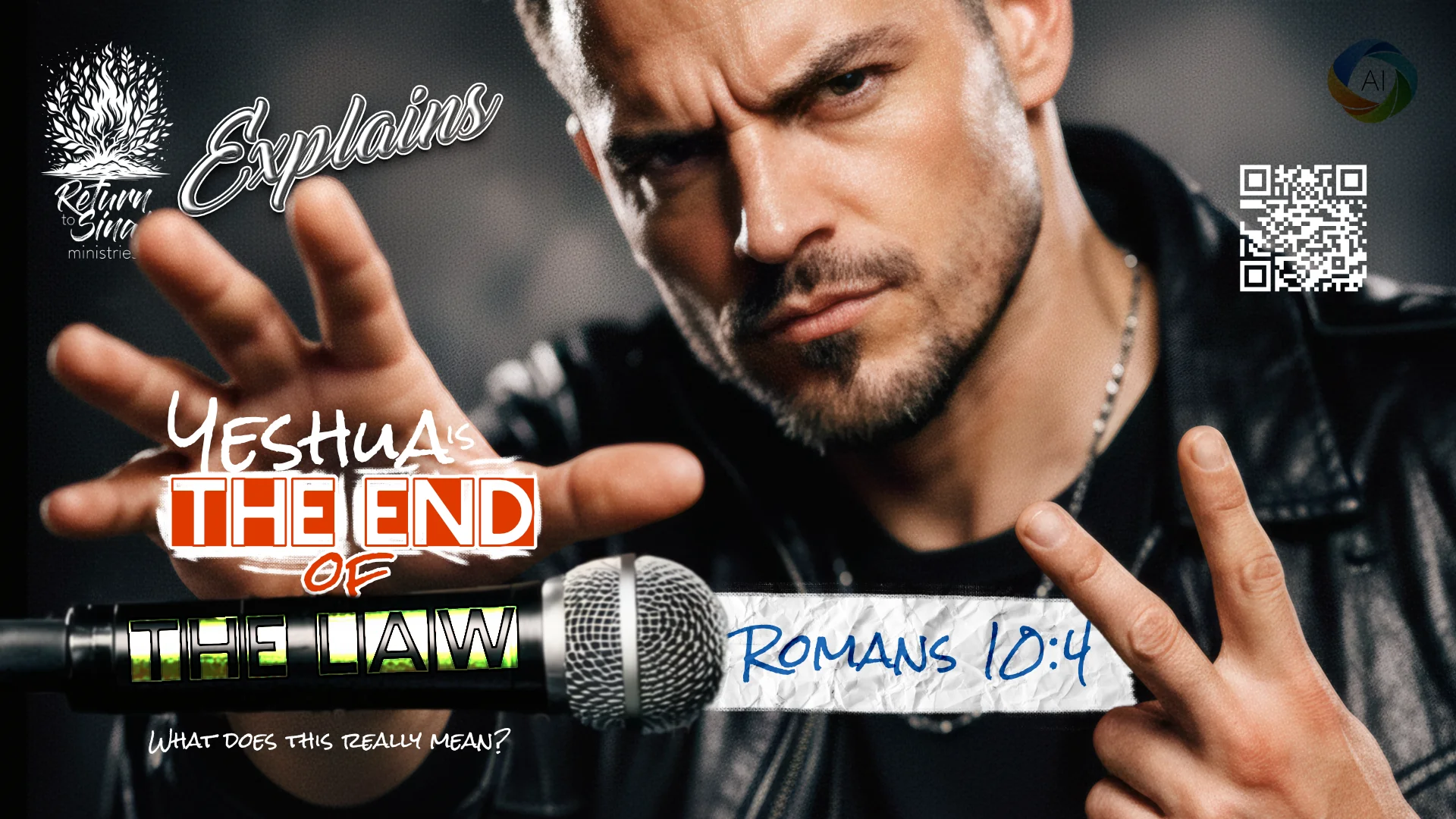
The End of the Law?
An excerpt of the commentary on Romans 10, coming sometime next month. Stay tuned this month for my commentary on Romans 9.
Romans 10:4 LSB — For Christ is the end of the law for righteousness to everyone who believes.
Ok, case closed, Yeshua got rid of the Law… or did He?
As Peter (Kefas) mentioned in his letters, we have to be careful of teachers that manipulates the teachings of Paul for their own destruction:
2 Peter 3:14-16 LSB ~
Therefore, beloved, since you are looking for these things, be diligent to be found by Him in peace, spotless and blameless, and consider the patience of our Lord as salvation, just as also our beloved brother Paul, according to the wisdom given him, wrote to you, as also in all his letters, speaking in them of these things, in which are some things hard to understand, which the untaught and unstable distort, as they do also the rest of the Scriptures, to their own destruction.
When you read the Bible, keep in mind, that in its original state, the Bible did not have chapters and verses, that was a tool added later for easy navigation, but was never intended to split its content apart.
What do I mean by it? Well, to understand what the single verse 4 of Chapter 10 in the letter to the Romans, you need to read the context from Chapter 1 to this point.
Saul (Paul) was addressing his sadness about his people in the previous chapter 9; he is telling us how they are missing the point of the Law given by God, first from the beginning, the oral Torah, later written in stone on Sinai.
And how are they missing the point? They are missing the point because they are missing the goal of the Torah (the Law). What is that goal? That goal is Messiah Yeshua.
How do I know this is the proper interpretation?
First, we have to agree that Paul would have never disagree with Yeshua. By doing so, he himself would have encourage you not to listen to him.
Galatians 1:6-9 LSB ~
I marvel that you are so quickly deserting Him who called you by the grace of Christ for a different gospel, which is really not another, only there are some who are disturbing you and want to distort the gospel of Christ. But even if we, or an angel from heaven, should proclaim to you a gospel contrary to the gospel we have proclaimed to you, let him be accursed! As we have said before, so I say again now, if any man is proclaiming to you a gospel contrary to what you received, let him be accursed!
With that said, we know that Saul would never contradicts this that came directly from the mouth of Yeshua.
Matthew 5:17 LSB ~ “Do not think that I came to abolish the Law or the Prophets; I did not come to abolish but to fulfill.
So, what is the difference between abolish, fulfill and end?
I’m glad you asked…
To understand what the concept of not abolishing and fulfilling the law means, we need to understand the words used in the original koine Greek, the suspected original language used to transmit the Gospel and the Letters of Paul.
First, let us start with the word “end”, used in the Romans 10:4, since that is the word that started this conversation. The word which we use to translate to “end” is the koine Greek —τέλος telos.
(Strong G5056) τέλος ~ telos; a prim. word; an end, a toll: — completion, consequence, continually, custom, end, ends, finished, goal, outcome, sum, tolls, utmost.
The word “telos” meaning in this instance is closely related to —goal— and actually if you see closely, or follow the footnotes of your Bible, you will find that in many translations, the word translated to is “goal” instead of “end”, because is less misleading.
As in the Complete Jewish Bible, which the verse reads as follow:
Romans 10:4 CJB ~ For the goal at which the Torah aims is the Messiah, who offers righteousness to everyone who trusts.
This word is similar to the word used in Matthew 5:17 for “fulfill”, but they are different. The word “fulfill” in this verse was translated from the koine Greek — πληρόω (plēroō).
(Strong G4137) πληρόω plēroō ~ from 4134; to make full, to fulfill, complete: — approaching, be complete, been filled, been fulfilled, complete, completed, elapsed, fill, filled, fills, finished, fulfill, fulfilled, fulfilling, fully carry out, fully preached, made complete, made full, make me full, passed.
plēroō does not mean “to end by replacing.” It means to bring something to its intended fullness, like filling a cup to the brim or completing a pattern.
Which is a key contrast to the word —καταλύω (kataluō)— the original koine Greek word which is translated to “abolish” in many of the current translations of the Bible.
(Strong G2647) καταλύω kataluō; from 2596 and 3089; to tear down, destroy, overthrow; abolish; to find lodging: — abolish, destroy, destroyed, guest, obtain lodging, overthrow, overthrown, tear down, torn down.
In the entire book of Matthew this word, and its variant, was used to emphasize destruction, like when the false witnesses gave testimony to what Yeshua said about destroying the temple and putting it back together again in three days (Matthew 27:40).
This puts in perspective the message Yeshua was trying to convey to the people in the Sermon of the Mount, which can be understood as this:
I did not come to destroy or done away with the Law of My Father. The Law has a goal, and I have come to bring that goal to fruition. I am the fulfillment of Torah.
Yeshua came to bring the promises of Yahweh to its fullness, to its end goal, and this is what Saul (Paul) was trying to convey in Romans 10:4.
The goal of the Law is Yeshua the Messiah
And what is the goal of the Law and the Prophets?
Jeremiah 31:32 CJB ~ “For this is the covenant I will make with the house of Isra’el after those days,” says ADONAI: “I will put my Torah within them and write it on their hearts; I will be their God, and they will be my people.
Ezekiel 36:26-27 CJB ~ I will give you a new heart and put a new spirit inside you; I will take the stony heart out of your flesh and give you a heart of flesh. I will put my Spirit inside you and cause you to live by my laws, respect my rulings and obey them.
Yeshua came to fulfill all this, He came to soften our hearts with the Love of the Father, He prepared the way for us to receive the Ruach, and engraved the Torah in our hearts so we can be able to walk like He walked, to love as He loved us, and show mercy as He shows mercy with us.
My question to you is, actually two questions.
How do you say you love if you think His law is burdensome, hard and difficult, and love is the foundation of Torah?
Do you truly believe in Him and what He has done for you?
Now, you should do the following question to yourself.
How can I trust this is the true interpretation of the passage?
By reading the context. You, as the reader, do not have to agree with the interpretation I’m giving you. Our challenge as believers of Yeshua is to meditate in His Law and commandments, day and night.
If you are truly seeking, earnestly, and you have taken the first step, believing that Yeshua is the Son of Yahweh, who died for your sins, and resurrected in the third day. Yahweh will put His Ruach (Spirit) in you, so you can follow His instruction and uphold His statutes. The Spirit will reveal to you His sound doctrine.
Shalom
Leave a Reply