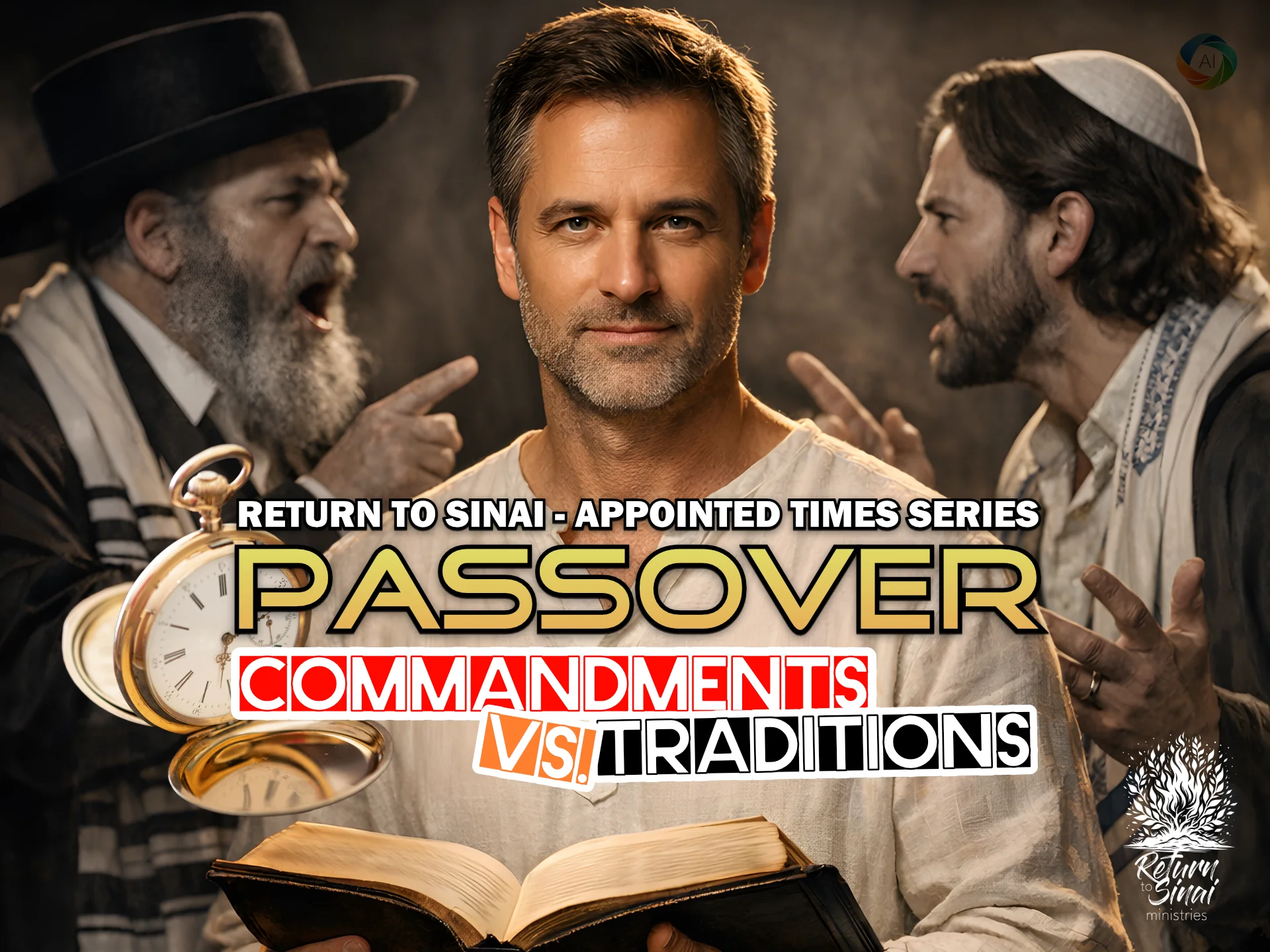
While most of the Christian world celebrates Easter, or Spring, believers and followers of Yeshua should celebrate the established appointed time and as suggested by the Apostle Paul to the Corinthians.
Your boasting is not good. Do you not know that a little leaven leavens the whole lump? Clean out the old leaven so that you may be a new lump, just as you are in fact unleavened. For Christ, our Passover lamb, also was sacrificed. Therefore let us celebrate the feast, not with old leaven, nor with the leaven of malice and wickedness, but with the unleavened bread of sincerity and truth.
1 Corinthians 5:6-8 • Legacy Standard Bible (LSB)
Not under manmade calendars but under Yahweh’s. Yahweh is the Elohim of Avraham, Yitzkhaq and Yaacov (Abraham, Isaac and Jacob). Why? Because that’s how Ha‑Shem appointed them to be celebrated.
And you shall tell your son on that day, saying, ‘It is because of what Yahweh did for me when I came out of Egypt.’ And it will be as a sign to you on your hand and as a memorial between your eyes, that the law of Yahweh may be in your mouth; for with a strong hand Yahweh brought you out of Egypt. Therefore, you shall keep this statute at its appointed time from year to year.
Exodus 13:8-10 • Legacy Standard Bible (LSB)
How to celebrate Passover?
There’s only one way to celebrate Passover, but which is that way. Rabbinic traditions brought many beautiful traditions to the Pesakh, but what is really the Passover established by Yahweh?
Here is the list of instructions from the Torah.
First —who can participate of the Pesakh Meal?
The Festival of Passover is in essence a time to gather as family to remember what Yahweh has done for us, back in the land of Egypt and our liberation through the Messiah from our Egypt, which is metaphorically —the concept of Sin. The Pesakh Meal is part of the celebration, but do not mistake the festival of Passover and Unleavened Bread with the Pesakh Meal.
With this in perspective, these are the instructions from the Torah of whom is eligible to participate of the Pesakh Meal:
- The celebration of Passover can be celebrated by any believer, but only believers that are circumcised (see point 4) can actually participate of the Pesakh meal (the traditional ordered meal, the sacrifice and the wine). (Exodus 12:48). See next three points what constitute a believer in the sight of Yahweh.
- A person that is friend of Yahweh’s teachings but does not abide to His ruling, is considered a foreigner, and foreigners cannot participate of the Pesakh meal. This includes Christians that believe in the doctrine of dispensation (who believe Yahweh replace Israel with the Church). Since this is not a teaching extracted from neither the Tanach nor the Brit Kha-Dasha, this person is considered a foreigner of the nation of Israel. (Exodus 12:43-45)
- Anyone who believe, like Paul believed, that we have been grafted into the nation Yahweh established, independent of modern gubernamental structure, from Yahweh’s perspective you are a sojourner, as long as you are circumcised you can participate of the Seder. (Exodus 12:47‑48 , Numbers 9:12).
- Important Note for Believer of Yeshua: Based in the writings of Paul, baptism is considered the circumcision for non-Jewish believers of Yeshua, as the covenantal sign through the works of Yeshua. Is at your discretion if this qualifies you to participate of the Pesakh. From my understanding of Torah, the circumcision is an essential part, you can still participate of the Pesakh (Passover), but not to partake of the meal. But again, is at your discretion if you feel qualified, baptized believers were able to participate of the Yeshua’s Supper which is part of the Pesakh Meal. So, I’m still debating these points in my mind (Galatians 3:27-29, Colossians 2:11-15, Philippians 3:1-5). Since this is an ambiguos matter that has not been settle, I would suggest, if you participate of the meal, to pray the prayer of Hezekiah over Israel when he reinstituted the Passover in Israel after centuries of Israel neglecting it, over your house.
And they stood at their stations according to the legal judgment for them, according to the law of Moses the man of God; the priests splashed the blood which they received from the hand of the Levites. For there were many in the assembly who had not set themselves apart as holy; therefore, the Levites were over the slaughter of the Passover lambs for everyone who was unclean, in order to set them apart as holy to Yahweh. For a multitude of the people, even many from Ephraim and Manasseh, Issachar, and Zebulun, had not cleansed themselves, yet they ate the Passover otherwise than what was written. For Hezekiah prayed for them, saying, “May Yahweh, who is good, atone for everyone who prepares his heart to seek God, Yahweh, the God of his fathers, though not according to the rules of cleansing of the sanctuary.” So Yahweh heard Hezekiah and healed the people.
2 Chronicles 30:16-20 • Legacy Standard Bible (LSB)
Second — When do we celebrate Passover? During Easter?
We as believers of Yeshua should not celebrate and worship Yahweh as the world celebrates and worship their gods and traditions. So, no, we don’t celebrate Spring, we celebrate the mighty works of Yahweh, in the time they have been appointed.
- The Passover, as any of the Festival and Days of Observance established by Yahweh, should be observed and celebrated at the time they were appointed. (Leviticus 23:12)
- The day appointed by Yahweh was as followed. In the first month, on the 14th day of the month. The month is named by Yahweh as the month of Aviv (Abib). The month of Aviv is determined by the state of the barley, when is ready almost at the point of harvest. This date should not be determined by clever systems or calculations. Like a modern calendar, dating systems or traditions. (Leviticus 23:4). This is true for all the appointed times, including Shabbat.
- Depending in the sights of the new moon and the establishment of the beginning of the year, the day of Passover normally falls either on April or March from the Gregorian Calendar. The observance of the sliver of the new moon marks in Biblical times the beginning of the month. Pesakh, as well as Succoth, always falls and are celebrated during the full moon (the middle of the month), which makes it easier to work outside during the night where the moon is at it brightest.
- If on a distant journey or because of uncleanness, the Passover should be celebrated a month later, the 14th day of the second month. (Numbers 9:3-8)
- Whenever you celebrate, in the first or second month, the day you celebrate the Seder marks the beginning of the Festival of Unleavened Bread, right next day, the 15th day of the month. the Passover is just celebrated for a night, on many occasions the Festival of Passover or the Festival of Unleavened Bread are mentioned interchangeably because they are celebrated one after the other, so both together were occasionally mentioned as one and the same. (Exodus 34:25)
Third – Are we to sacrifice the Passover lamb?
This again is a tricky question. Depending on whom you ask you might get different answers. A Rabbi will tell you a flat out “No”, because we do not have the Temple where to make the sacrifices. A Messianic might tell you “Yes” or “No” depending which train of thought they follow. If you ask a Christian they will also respond with a flat-out definite “No”, because Yeshua is our sacrificial lamb who was sacrificed once and for all.
And if you listen to any of their arguments you can deduct, they are all right. How come? Let’s put things in perspective.
- The Passover lamb was established that can only be sacrificed where Yahweh established His name, this after the first Passover. During the first Passover, there was no place on earth where Yahweh established His name, but in a small group of people, which were in covenant with Him because of Abraham, Isaac and Jacob. Because of His faithfulness, Yahweh was fulfilling His promised to Abraham to rescue Israel from the foreign land of Egypt. (Genesis 15:13-15). But as of today, Yahweh has established His name in a physical place we call Yerushalayim (Jerusalem). If this is true, which is Biblically true, we cannot sacrifice other than in Yerushalayim.
- But again, Yahweh also established His name in Yeshua. Which is not a new thing done in the Brit Kha-Dasha (New Testament). Since the Angel of the Lord had the name of Yahweh on Him (Exodus 23:20-21). But hold your horses, don’t jump to conclusions yet, Yeshua return to His father, what has been put in our heart is the Spirit of Yahweh. In context, Yahweh did not establish His name in you, you are called His temple if the Spirit of God dwells in you. This is not an automatic transaction by believing. As Paul hinted in Romans 8:9, “if indeed the Spirit of God dwells in you”. So based in these arguments I cannot tell you that you can sacrifice the lamb. You can slaughter a lamb and serve it as part of the festivities but cannot be called the Sacrificial Lamb. (Deuteronomy 16:3-8)
- In the case you travel to Yerushalayim during the festival, you might be able to meet with believers that would celebrate the festival as well, but as far as I know, no one will sacrifice a lamb since the Rabbis nor most Messianic practice this sacrifice. There are groups in the States that do, but they do so completely violate the Passover as established in the Bible.
- If you want to eat a lamb as an observance, but not as the sacrifice, these are the laws concerning the lamb or goat:
- If you are going to have a lamb slaughter, it has to be done by the head of the family, or by a priest.
- If you are buying a lamb or goat, make sure is Kosher nor Hallal. Hallal is an Islamic procedure that dedicates the meat with blessings from Allah, who is a foreign god, not the god of Israel. Hence idolatry.
- Has to be eaten fully cooked with bitter herbs and unleavened bread. (Exodus 12:8)
- The lamb or goat need to be roasted and cannot have a broken bone in it. (Exodus 12:9)
- The lamb or goat has to be eaten before the morning light when sunrise arrive, if you suspect some will be left, it should be burned before sunrise. (Exodus 12:10)
- You have to have enough lamb to feed any guest in the house that’s participating, and it cannot be too much nor scarce. The amount should be right. (Exodus 12:10)
Biblical facts vs traditions
As with many holidays, throughout the years, many traditions are added, some good that enhance the experience of the commandments, and some have become burdensome.
The Seder for example, is not a Biblical custom, but a tradition added to create and order and consistency of teaching the true of the purpose for the tradition. As we posted at the beginning, this is what Yahweh told Moshe and Aaron:
And you shall tell your son on that day, saying, ‘It is because of what Yahweh did for me when I came out of Egypt.’ And it will be as a sign to you on your hand and as a memorial between your eyes, that the law of Yahweh may be in your mouth; for with a strong hand Yahweh brought you out of Egypt. Therefore, you shall keep this statute at its appointed time from year to year.
Exodus 13:8-10 • Legacy Standard Bible (LSB)
Yahweh explicitly asked the Israelis to teach the story of redemption, when Yahweh brought them out of Egypt, because of this, there’s a beautiful tradition where we tell the story to our children as a first-person witness of the event.
You will not tell the story as if this happened to some Israelites centuries ago, you tell it as you were there as such. You will teach the youngest children in the house to ask:
Why is this night different than the other nights?
Then you reply:
It is because of what Yahweh did for me when I came out of Egypt.
As a believer of Yeshua you can add:
Yahweh promised me a Messiah, that, as He brought our people out with a mighty hand from Egypt, the Messiah would set us FREE of the bondage of Sin with a mighty hand. Yahweh fulfilled this promised through Yeshua the Messiah.
It’s tradition to follow a Haggadah, a Hebrew word meaning “Order” or “Service.” I shared the one offered by One For Israel, but the idea is to learn and create your own Haggadah. Of course, choosing to follow or purchase an already published one is perfectly fine. The Haggadah is designed to guide your guests and family through the Seder.
Seder from a Messianic Perspective
Seder from a Rabbinic Perspective
The most important part of the tradition which is actually a commandment established by Yahweh is to get rid of the leaven. Which teaches us how we should search our hearts for things that might cause conflict in our walk to holiness.
Seven days you shall eat unleavened bread, but on the first day you shall remove leaven from your houses; for whoever eats anything leavened from the first day until the seventh day, that person shall be cut off from Israel.
Exodus 12:15 • Legacy Standard Bible (LSB)
Later you find this illustration from Paul in 1 Corinthians 5:7
Clean out the old leaven so that you may be a new lump, just as you are in fact unleavened. For Christ, our Passover lamb, also was sacrificed.
1 Corinthians 5:7 • Legacy Standard Bible (LSB)
How many days?
Based in Rabbinic tradition, the Passover is celebrated one day in the land of Israel, but two days in the Diaspora. In the Bible we can only find the case mentioned previously about the case of uncleanness or long journey. So, where this tradition comes from? You can read it here.
With technology, the need of 2 days Passover celebration on the Diaspora is in question, even more so, when the Jewish Calendar has been set as well.
The truth of the matter is that Yahweh established to celebrate the Passover in the 14th day of the month of Aviv, and then 7 days of Unleavened Bread starting the next day, the 15th of the month. For me is more crucial to follow Yahweh’s commandments over men traditions.
The real challenge is to find out when the first month starts, if you are wanting to follow Yahweh’s method. And with this we rise many other questions:
- Does I need to follow the days based on the witnessing of the barley in Yerushalayim or can I follow the days based on my observations at home?
- Should I follow the Gregorian or the Hillel Calendar, or should I follow the observance established by Yahweh?
Those two questions I still try to figure out. I’m listening to many teachers and constantly praying to Yahweh to guide me.
For the moment, I choose to pray Hezekiah’s prayer:
May Yahweh, who is good, atone for everyone who prepares his heart to seek God, Yahweh, the God of his fathers, though not according to the rules of cleansing of the sanctuary.
There are many voices around, all with good and not so good arguments. If you are looking to follow Yahweh, truly understand that He is merciful and compassionate. He wants us to follow faithfully, and He sees our hearts. While we learn together, let trust Yahweh to search our hearts, rely on Yeshua’s work of redemption, and trust the Spirit will guide us to the truth.
We are very new to the walk of Torah, so this is just a little introduction. We will be adding more as the day approaches, and as we grow on our way back to Sinai.